


SOLD-OUT
Author: Francesco Mazzi
Title: The Fronds of Hope
Materials: canvas on panel, original oil painting MAZZI FINE ART, gold and silver, marble
Original MAZZI FINE ART frame, Italian stone and metal paint finish
Canvas dimensions: W100cm x H50cm x 4.5cm
Frame dimensions: L112xH62cm
TANABATA, LE FRONDE DELLA SPERANZA
TANABATA, THE LEAVES OF HOPE
Tanabata, one of the traditions that symbolizes summer in Japan.
Once a year, people write their wishes on strips of paper called tanzaku, tie them to bamboo branches, and entrust their hopes to the heavens. When the wind blows, the bamboo leaves begin to sway, creating a soft, rustling sound.
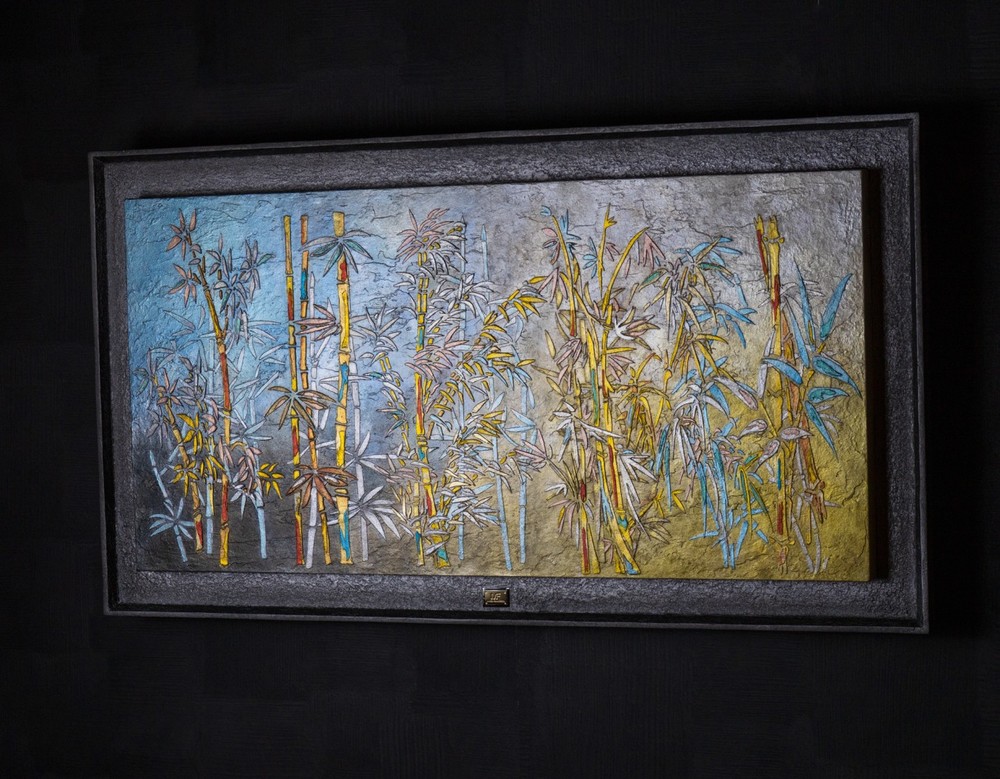
Tanabata, Le Fronde della Speranza — Tanabata, The Leaves of Hope expresses the moment when human wishes connect with the heavens, transformed into a single, dreamlike bamboo grove.
Rather than painting the tanzaku, the bamboo itself becomes the wish
In traditional Tanabata celebrations, five-colored tanzaku are tied to green bamboo branches.
Yet in this work, the tanzaku themselves do not appear. Instead, the eye encounters bamboo rising toward the heavens in blue, red, yellow, white, violet, and other tones.
The five colors of Tanabata are traditionally associated with the philosophy of the Five Elements, with meanings that reflect human aspirations and the principles of living well.
Wood — Blue: Growth
Fire — Red: Gratitude
Earth — Yellow: Human connection and trust
Metal — White: Responsibility and achievement
Water — Black / Violet: Learning and self-improvement
Rather than attaching these colors to the bamboo as small strips of paper, Mazzi transforms the bamboo itself into the colors of human wishes.
The bamboo, naturally green, is deliberately rendered without green.
Each stalk becomes a wish in itself.
The desire to grow. Gratitude. Connection with others. The determination to accomplish something. And the aspiration to rise even higher.
Carrying these different hopes, the bamboo stalks overlap one another and reach upward toward the heavens.
Painting wind, sound, and even the wishes that cannot be seen
Seen closely, the bamboo grove reveals itself as far more than a composition of simple vertical lines.
Stalks of different heights and thicknesses overlap in multiple layers, some rising almost straight, others taking on gentle, supple forms as they extend deeper into the scene and upward. Between them, countless bamboo leaves face different directions and overlap one another.
It is as though a breeze were passing through the grove at that very moment.
Each leaf and bamboo stalk is given dimensional form through MAZZI’s distinctive low-relief technique, over which multiple layers of color and material are built.
Behind them unfolds a delicate gradation in which gold and silver seem to dissolve into one another. A mysterious, moonlit glow spreads through the spaces between the bamboo, creating light and shadow across the raised leaves and stalks.
The wind itself cannot be seen.
Neither can the sound of the leaves, nor a human wish.
Yet through the supple movement of the bamboo, the overlapping leaves, the shadows created by the low relief, and the gradations of color and golden and silvery light, the viewer can almost sense the wind moving through the grove, hear the rustling of its leaves, and feel the hopes entrusted to the bamboo.
The moment a wish becomes light
On the night of Tanabata, people entrust their wishes to tanzaku and tie them to bamboo. The wind passes through the grove, and the leaves quietly begin to sound.
Beyond them, a mysterious golden and silvery light spreads through the work, as though receiving the wishes carried within the bamboo.
What Mazzi depicts is not simply the Tanabata festival itself.
The human desire to hope for the future.
The act of entrusting that hope to something beyond ourselves.
The moment when an invisible wish connects with the heavens.
And a Japanese tradition, together with the meanings it carries, passed down from generation to generation.
Without depicting a single tanzaku, Mazzi transforms the bamboo itself into human wishes, bringing wind, sound, and light together within a single scene.
That is Tanabata, Le Fronde della Speranza — Tanabata, The Leaves of Hope.

