


Author: Francesco Mazzi
Title: Red Harvest
Materials: canvas on panel, original oil painting MAZZI FINE ART, gold and silver, marble
Original MAZZI FINE ART frame
Canvas dimensions: W100cm x H50cm x 4.5cm
Frame dimensions: L112xH62 cm
RACCOLTO ROSSO
THE RED HARVEST
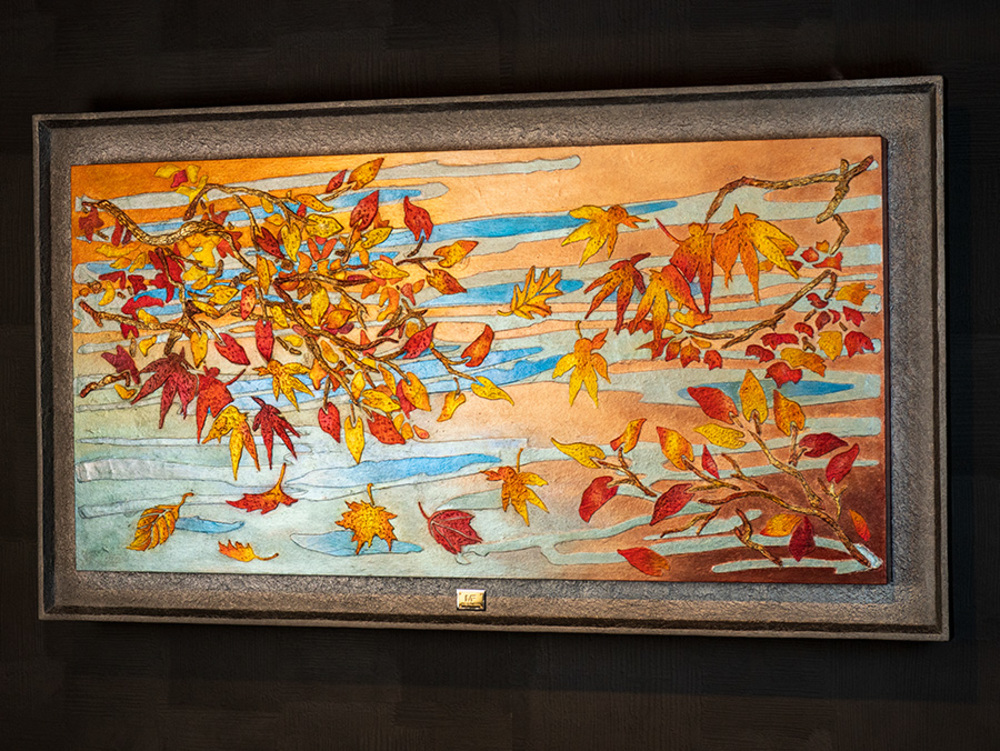
Raccolto Rosso — The Red Harvest is an artwork that expresses the changing colors of autumn in Japan and the beauty that exists only for a fleeting moment.
Across the background flows the clear, beautiful water of Japan.
Against its pure blue, branches of autumn trees extend boldly from both sides, their leaves spreading over the water in shades of red, vermilion, orange, and gold.
The first key to understanding this work lies in the contrast between
“the blue of the water” and “the red of the autumn leaves.”
It is because of the clarity of the blue water that the reds appear even more vivid.
And at the same time, it is because of the intensity of the red leaves that the blue of the water feels even purer and more beautiful.
The two colors do not exist in opposition. They exist to reveal and intensify the beauty of one another.
Looking more closely, the blue of the water is not uniform.
The surface receives and reflects the colors of the surrounding foliage and the falling leaves, gradually taking on tones of red.
From blue to red.
The transition does not happen abruptly. It unfolds through delicate gradations of color, as though the water itself were slowly transforming into the colors of autumn.
And the “red” within this work is not a single red.
The autumn foliage of Japan changes into many different colors according to the trees and leaves themselves.
Deep crimson, vivid vermilion, orange, yellow, and gold.
Each leaf carries its own subtle variation of color, and it is the accumulation of these countless tones that gives the autumn landscape its depth.
In this work, the color red itself tells the story of autumn in Japan.
Not only the colors, but every form is created leaf by leaf
Seen from close range, another world begins to emerge.
Every individual leaf, as well as the branches and trunks, is shaped through MAZZI’s distinctive bas-relief technique.
Forms are created and layered, then built further through color and material.
As a result, the leaves are not simply motifs painted onto a flat surface. They physically rise from the artwork, catching the light and casting their own shadows.
For this reason, Raccolto Rosso continually changes its expression according to the viewing angle, the time of day, and the way natural light enters the space.
Seen in natural light, the work reveals a distinctive luminosity that photography alone cannot fully capture.
Color, materials such as pure gold and silver, the relief of the surface, and the light that falls across it.
When all of these elements come together, the artwork reveals another expression.
Why this scale?
The canvas of Raccolto Rosso measures 100 cm in width, reaching 112 cm with its frame.
Yet this scale was not chosen simply to create a “large artwork.”
Branches extending inward from both sides.
Water flowing through the landscape.
Leaves carried by the wind and falling toward its surface.
And colors shifting from blue into red.
All of these elements come together within a single landscape, creating a sense of depth and presence that allows the viewer to feel as though they were standing within the Japanese autumn itself.
This is the scale necessary to create that experience.
Viewed from a slight distance, the branches spreading across the composition and the flowing water become one expansive space, drawing the viewer into the landscape.
What is depicted is not simply a reproduction of a landscape
This is important not only in understanding Raccolto Rosso, but also in understanding MAZZI’s work as a whole.
The purpose is not to reproduce trees, flowers, water, or animals exactly as they appear in nature.
What is expressed is the story and emotion that exist beyond the visible landscape.
The light that can only be encountered in that season.
Color.
Water.
Air.
The fleeting moment in which nature begins to change.
And the emotions that arise within us when we stand before such a landscape.
To preserve within the artwork even what cannot be seen.
It is for this reason that MAZZI’s distinctive use of color and gradation, bas-relief, and the layering of different materials came into being.
Color and form are gradually built upon one another, while the character of each material and its relationship with light are carefully observed until the landscape takes shape.
Technique does not exist merely to display technique.
It exists because it is necessary to express the story within the landscape — and the emotions that cannot be captured through words alone.
“The Red Harvest”
The colors created by autumn eventually fall away as nature moves toward the next season.
Yet if the beauty of that fleeting moment can be preserved within an artwork, its story can continue into the future, even as time and generations change.
A harvest not of fruit, but of color.
The countless reds created by autumn in Japan.
The fleeting beauty of that moment, gathered and preserved within a single work.
That is Raccolto Rosso — The Red Harvest.

